Research Paper
Generative AI for International Market Research and Global Competitive Intelligence: A Framework and Public-Source Case Study of India’s Label Industry
Abstract
Generative artificial intelligence (GenAI) is increasingly relevant to business research because it can help organize large volumes of information, extract comparable attributes from documents and support preliminary assessments of foreign markets. These capabilities are particularly relevant to small and medium-sized enterprises (SMEs), which may lack dedicated market-intelligence teams. The value of AI-assisted research, however, depends on the quality of the sources, the consistency of the comparisons and the interpretation of the resulting evidence. This paper develops a practical framework for integrating GenAI into international market research and global competitive intelligence. It combines a focused narrative review of academic and institutional literature with a qualitative public-source case study of India’s label industry. Corporate disclosures from Avery Dennison and CCL Industries are examined to compare product capabilities, technology initiatives, geographic signals and the limits of publicly available competitor information. The case illustrates the difference between documented company statements and conclusions that require additional evidence. Avery Dennison’s public announcements describe RFID-related production and product development in Pune, while CCL Industries’ corporate reporting describes a broad label and specialty-packaging portfolio. These materials support a comparison of disclosed capabilities, but they do not provide a directly comparable basis for assessing the companies’ India-specific market shares, prices or commercial performance. The paper presents a six-stage workflow linking decision definition, source planning, evidence extraction, consistency checks, market screening and managerial interpretation. It concludes that GenAI is most appropriately treated as an analytical aid within a traceable research process, with conclusions proportionate to the evidence available.
Keywords: Generative artificial intelligence, international market research, competitive intelligence, international market selection, labels, small and medium-sized enterprises, source evaluation, human–AI collaboration
I. Introduction
A. Background
International expansion requires firms to assess demand, customer requirements, competitors, regulations, logistics, distribution channels and the economics of serving a market. For small and medium-sized enterprises (SMEs), gathering this information across multiple countries can be costly and time-consuming. Public statistics, company websites, regulatory portals, technical documents and industry publications provide useful evidence, but their definitions, reporting periods and geographic coverage often differ.
Generative artificial intelligence (GenAI) can assist with several early-stage research tasks, including translating a broad business question into a search plan, summarizing lengthy documents, organizing competitor attributes and identifying gaps in available information. Noy and Zhang (2023), in a preregistered experiment involving 453 college-educated professionals completing writing tasks, reported a 40% reduction in average completion time and an 18% increase in assessed output quality. These results demonstrate productivity effects in the experimental setting; they do not establish that AI-assisted market research is necessarily accurate or improves export outcomes.
The World Trade Organization (WTO, 2024) discusses the potential of AI to influence trade costs and productivity alongside concerns about access, governance and intellectual property. For international business, the relevant issue is therefore not simply whether GenAI can produce a summary, but whether the research process connects that summary to current, suitable and verifiable evidence.
B. Problem Statement
The central research problem is how GenAI can support international market research and competitive intelligence without allowing unsupported claims, inconsistent comparisons or weak source selection to shape business decisions. A source may be genuine but fail to support the claim attributed to it; an accurately reported statistic may also be insufficient to justify a market-entry decision. These risks become more consequential when official statistics, corporate disclosures and generated summaries are combined in a single analysis.
C. Research Question
How can GenAI support international market research and global competitive intelligence for SMEs while keeping market assessments traceable, comparable and commercially relevant? The study addresses five related questions: (i) Which research tasks can GenAI support during preliminary international market screening? (ii) What source and interpretation errors can weaken AI-assisted research? (iii) What can public company disclosures establish about competitors in India’s label industry? (iv) How can trade, regulatory, customer and logistics evidence be organized within a market-screening process? (v) What workflow connects AI-assisted research with a defensible managerial assessment?
D. Aim and Objectives
The aim is to develop and illustrate a practical framework for using GenAI in international market research and competitive intelligence, using public-source evidence from India’s label industry. The specific objectives are to: (i) review research on GenAI productivity, hallucination, retrieval, human–AI collaboration and international market selection; (ii) identify appropriate roles for GenAI across a structured research workflow; (iii) compare publicly documented competitive signals from Avery Dennison and CCL Industries; (iv) establish how official trade statistics fit within a broader market-screening process; and (v) define a repeatable decision framework that distinguishes evidence-based findings from untested assumptions.
E. Scope and Contribution
The study combines a focused narrative literature review with a qualitative public-source case study. The company comparison examines disclosed capabilities and strategic signals rather than attempting to rank overall corporate performance. HS 482110 refers to printed paper or paperboard labels and represents only one segment of the wider label industry; it does not capture every plastic, RFID, tire-label or specialty-label product. The paper’s contribution is an applied workflow that connects AI-assisted discovery with source evaluation, structured competitor comparison and preliminary market screening.
II. Literature Review
A. GenAI and Knowledge-Work Productivity
Noy and Zhang (2023) provide experimental evidence that GenAI can improve speed and assessed quality in specific professional writing tasks. The relevance of these findings to international market research is indirect. Market research involves current information, product classification, quantitative consistency, regulatory accuracy and judgments about whether a firm can serve a market profitably. Productivity results from writing tasks therefore establish a basis for examining GenAI’s potential, rather than proof of its effectiveness in market-entry decisions. For SMEs, the potential operational benefit lies in reducing the time required to locate, organize and summarize information. The net benefit depends on the time spent verifying outputs and correcting errors. An efficient research process must therefore consider both the speed of information processing and the reliability of the final analysis.
B. Hallucination, Factuality and Source Attribution
Ji et al. (2023) review hallucination in natural-language generation and document how generated content can diverge from source information. In business research, this may appear as an incorrect statistic, an outdated regulatory statement, an unsupported competitor attribute or a citation that does not substantiate the associated claim. Bender et al. (2021) further discuss the limitations and risks associated with large language models, emphasizing the importance of examining how generated language relates to evidence and context.
Three forms of evaluation are relevant. Source validity concerns whether a source exists and is relevant. Claim support concerns whether the source contains evidence for the specific statement. Interpretive validity concerns whether the conclusion follows from the evidence. A source can be authentic without supporting a particular claim, and a correctly extracted fact can still be used to reach an unjustified strategic conclusion.
C. Retrieval-Augmented Generation and Evidence-Grounded Work
Lewis et al. (2020) introduced retrieval-augmented generation (RAG), a method that combines language generation with retrieved documents. Retrieval can connect generated responses to external information, but it does not independently guarantee source quality, completeness or correct interpretation. Researchers must still assess whether sources are official, current, geographically relevant and aligned with the product or market being studied.
Quantitative analysis requires particular care. Reporting period, currency, unit, product code, partner definition and data source affect whether figures can be compared. Original tables and metadata provide a stronger basis for calculation than summaries that omit these details. Differences between datasets may reflect classification or reporting differences rather than a substantive change in the market.
D. Human–AI Collaboration and Management Decisions
Jarrahi (2018) argues that AI and human judgment can complement one another in organizational decision-making. Raisch and Krakowski (2021) describe the tension between automation and augmentation: AI can take over selected tasks while also supporting human work. In international market research, GenAI can organize evidence and generate possible explanations, while researchers and managers retain responsibility for assessing context, relevance and commercial implications. Human review does not automatically guarantee accuracy. Reviewers may accept fluent explanations without inspecting the underlying source. Effective oversight therefore depends on explicit verification criteria, reproducible calculations and transparent treatment of uncertainty.
E. International Market Selection and SME Export Performance
International market selection is a multi-criteria decision rather than a ranking based only on market size. Brouthers and Nakos (2005), using a sample of Greek exporting firms, found an association between systematic international market-selection methods and export performance after accounting for firm and decision-maker characteristics. Their findings support structured screening, while leaving room for industry-specific criteria and differences in firm capabilities.
For a label manufacturer, relevant criteria may include demand by end-use industry, substrate and adhesive requirements, printing capacity, quality certification, freight cost, lead time, import duties, customer access and payment risk. A high import value alone does not establish that a product category is commercially accessible to a particular firm.
F. AI and International Trade
The WTO (2024) examines how AI may affect trade costs, productivity and economic opportunities, alongside governance and access challenges. This institutional perspective places AI-assisted market research within the wider international-business environment. Broad claims about AI’s potential effects on trade, however, are distinct from evidence that an individual SME will acquire customers or improve export performance by using a language model. Official trade resources, including the Government of India’s Export Import Data Bank (TradeStat), UN Comtrade and the World Bank’s World Integrated Trade Solution (WITS), provide different routes to product- and partner-level trade information. Their use in market screening depends on appropriate product classifications, reporting periods, units and partner definitions.
G. Competitive Intelligence from Public Sources
Competitive intelligence is the structured collection and interpretation of information about competitors, customers, suppliers and market conditions. Public sources include annual reports, product pages, official announcements, technical documents, regulatory filings and trade-fair disclosures. These materials can establish what a company publicly reports about its products, investments or capabilities. They rarely establish market share, customer satisfaction, price competitiveness or strategic intent without additional evidence. GenAI can help extract attributes from public sources, but analysis must preserve the distinction between observation and inference. An announcement of a production facility establishes a disclosed investment and location; it does not, by itself, establish market leadership, cost advantage or commercial performance.
H. Literature Synthesis and Research Gap
The literature establishes three relevant points: GenAI can assist selected knowledge tasks; generated information can be unreliable; and international market selection benefits from systematic criteria. The applied problem is how to combine these insights in a workflow suitable for SMEs using public sources. This study operationalizes that connection through defined research stages, evidence rules and decision boundaries, then illustrates the approach through a comparison of public disclosures in India’s label industry.
| Source | Year | Focus | Relevance to the Study |
|---|---|---|---|
| Noy & Zhang | 2023 | Experimental productivity study (453 professionals) | GenAI improves speed and assessed quality in writing tasks |
| Ji et al. | 2023 | Hallucination survey in NLG | Generated content can diverge from sources; relevance to factuality |
| Bender et al. | 2021 | Risks of large language models | Examines how generated language relates to evidence and context |
| Lewis et al. | 2020 | Retrieval-augmented generation (RAG) | Connects generation to retrieved documents; basis for evidence grounding |
| Jarrahi | 2018 | Human–AI symbiosis in decisions | AI and human judgment complement in organizational decisions |
| Raisch & Krakowski | 2021 | Automation–augmentation paradox | AI takes over tasks while supporting human work |
| Brouthers & Nakos | 2005 | SME export performance and market selection | Systematic market selection supports export performance |
| WTO | 2024 | AI and international trade | Places AI market research in the trade and governance context |
III. Research Methodology
A. Research Design
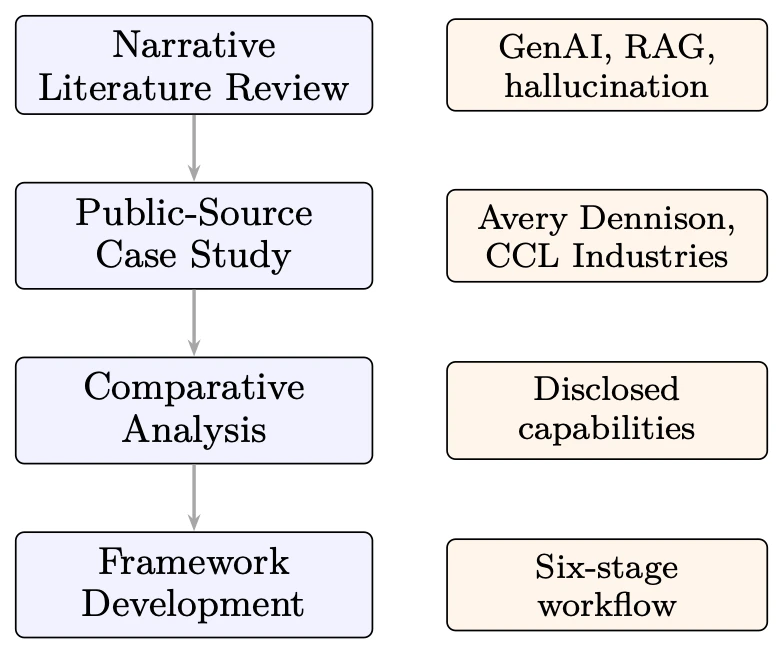
The study uses a focused narrative literature review and a qualitative public-source competitive-intelligence case study. India’s label industry is the case context, and Avery Dennison and CCL Industries are the focal companies because their public corporate materials describe label-related products and capabilities. The design supports a structured comparison of documented signals rather than a definitive ranking of company performance.
B. Source Selection and Evidence Treatment
Academic sources were selected for relevance to GenAI productivity, hallucination, retrieval, human–AI collaboration and international market selection. Institutional sources provide context on AI and trade, while company-level evidence is drawn from official corporate websites, company announcements and annual-report materials. Trade-statistics resources are considered as part of the market-screening framework.
Evidence is treated according to its source and geographic scope. Corporate statements are recorded as company-reported disclosures; interpretation is kept separate from direct statements. Global portfolio information is not treated as equivalent to India-specific evidence. Likewise, product capability statements are not interpreted as evidence of sales volume, market share, capacity utilization or price competitiveness.
C. Case-Study Procedure
The case-study procedure involves: (i) defining the business question around the public evidence available on label-industry capabilities and positioning; (ii) identifying primary company sources describing products, capabilities, investments or geographic presence; (iii) recording explicit claims alongside source titles, publication dates and URLs; (iv) comparing the companies using common analytical dimensions while retaining differences in geographic coverage and disclosure detail; and (v) separating direct observations from interpretation and identifying the commercial questions that remain outside the scope of public disclosures.
D. Analytical Dimensions
Table II presents the analytical dimensions used for evidence examination and the interpretive boundary for each dimension.
| Dimension | Interpretive Boundary |
|---|---|
| Product & technology | A stated offering does not establish sales volume or market share. |
| Geographic presence | A disclosed location does not establish capacity utilization or cost advantage. |
| Target applications | Named sectors do not prove customer concentration or commercial success. |
| Competitive signal | Signals may indicate priorities but do not prove future strategy or performance. |
| Market-entry relevance | Commercial conclusions depend on product fit, cost, customer and regulatory evidence. |
E. Role of GenAI in the Research Framework
The framework assigns GenAI a supporting role in source discovery, attribute extraction, evidence-gap identification and preliminary synthesis. The case comparison is based on public corporate sources and is not a controlled evaluation of a language model. Accordingly, the study’s findings concern the structure and interpretation of public-source competitive intelligence, rather than measured changes in research time or accuracy.
F. Public-Source Extraction Example
Avery Dennison’s official announcement dated 24 April 2025 states that the company opened an India-based RFID inlay and label production facility in Pune and introduced the AD Cobra RFID inlay for the Indian market (Avery Dennison, 2025). These statements provide evidence of a disclosed local-production and product-development initiative in RFID-related labels. The announcement is relevant to analysis of local production, product adaptation and RFID capability. It does not establish the facility’s production volume, utilization, profitability, relative price or market share. The distinction between the announcement itself and its possible business implications is central to the study’s evidence-treatment approach.
G. Ethical and Analytical Boundaries
The study uses public corporate and institutional material. It does not attempt to infer confidential information or non-public company strategy. Company descriptions are treated as corporate disclosures rather than independent proof of market leadership. Conclusions remain limited to the information and comparisons directly supported by the sources examined.
IV. Applied Case Study: India’s Label Industry
A. Case Context
Labels support product identification, packaging, compliance and supply-chain information. The sector includes printed paper labels, pressure-sensitive film labels, RFID-enabled intelligent labels and other specialty products. These categories serve different customers and may involve different materials, production requirements and trade classifications. Defining the product segment is therefore important when comparing competitors or screening export markets. The case examines public competitive signals from Avery Dennison and CCL Industries. The focus is on documented capabilities and the geographic scope of available disclosures, not on estimating the total size of India’s label market.
B. Avery Dennison
On 24 April 2025, Avery Dennison announced the opening of its first India-based RFID inlay and label production facility in Pune and introduced AD Cobra, an RFID inlay designed for the Indian market. The company described applications for RFID across apparel, pharmaceuticals, fast-moving consumer goods, logistics and retail (Avery Dennison, 2025). Avery Dennison’s public material also describes an intelligent-label innovation facility in Pune and label solutions spanning paper, film and intelligent-label applications (Avery Dennison, 2019; Avery Dennison, n.d.). Taken together, these disclosures show that the company publicly emphasizes materials, RFID and supply-chain visibility within its India-facing activities. They do not establish the company’s Indian sales, market share in conventional printed labels or prices relative to smaller suppliers.
C. CCL Industries
CCL Industries’ annual reports and investor materials describe its specialty-label and packaging businesses. Its corporate disclosures cover label applications across consumer products and healthcare, including pressure-sensitive labels and other specialty solutions (CCL Industries, 2024; CCL Industries, n.d.). These sources provide a broad view of the company’s product portfolio and a reporting structure through which its operations and financial performance can be examined. The sources used in this case do not provide a directly comparable India-specific market-share figure for CCL Industries and Avery Dennison across the label categories considered. The comparison therefore concerns documented capabilities and disclosure patterns, rather than a claim that one company is larger, cheaper or more successful in India.
D. Comparative Analysis
Table III summarizes the comparative analysis across four dimensions: technology and offer, India-related evidence, applications, and potential strategic signal.
| Dimension | Avery Dennison | CCL Industries | Interpretation |
|---|---|---|---|
| Technology and offer | Public announcement of RFID inlay and label production in Pune; intelligent labels and RFID applications. | Corporate material describes a broad specialty-label and packaging portfolio across several end-use industries. | Product fit and technology breadth are distinct competitive dimensions. |
| India-related evidence | A specific 2025 announcement about Pune production and an India-oriented RFID inlay. | The cited annual-report and corporate material is broader; equivalent India-specific evidence was not identified. | The evidence is asymmetric and does not establish relative overall position in India. |
| Applications | Apparel, pharmaceuticals, FMCG, logistics and retail for RFID applications. | Consumer products, healthcare and other label applications. | End-use categories can organize segment-level comparison, but do not establish customer concentration. |
| Potential strategic signal | Local production and product adaptation are explicit in the announcement. | Portfolio breadth and multiple end-use markets are visible in corporate disclosures. | The disclosures present different signals: localized RFID investment vs. broad specialty-label portfolio. |
| Not established | India-specific market share, comparable prices, utilization, profitability and customer-level outcomes. | India-specific market share, comparable prices, utilization, profitability and customer-level outcomes. | Capability statements cannot be converted into unsupported performance rankings. |
E. Interpretation
The comparison illustrates both the value and the limits of public-source competitive intelligence. Avery Dennison’s 2025 announcement provides a specific India-related investment and product signal. CCL Industries’ annual-report and corporate materials provide information about its label portfolio and served industries. These sources support a comparison of disclosed capabilities, but the geographic scope and level of detail are not equivalent.
The competitive relevance of a disclosed capability depends on the product segment under consideration. RFID-related investments may be relevant to manufacturers evaluating intelligent-label applications, but they are not automatically direct substitutes for conventional printed labels. Similarly, a broad specialty-label portfolio does not establish performance in a specific Indian product segment. Segment definition is therefore essential to the interpretation of company-level evidence.
F. Trade Statistics in Market Screening
Official trade statistics form one component of international market screening. The Government of India’s TradeStat system provides commodity- and country-level export and import views. UN Comtrade provides international merchandise trade statistics organized by product and partner, while the World Bank’s WITS platform supports access to and analysis of trade and tariff information (United Nations Statistics Division, n.d.; World Bank, n.d.).
Trade statistics are most informative when the product classification, reporting period, trade flow, quantity unit and partner definition are consistent. HS 482110 covers printed paper or paperboard labels and should not be treated as a complete proxy for the wider label industry. Product-level trade indicators can inform demand screening, but they do not independently establish customer access, achievable prices, regulatory fit or the profitability of serving a market.
V. A Practical Framework for GenAI-Assisted International Market Research
This section presents a six-stage workflow that connects AI-assisted discovery with source evaluation and managerial interpretation. Figure 2 illustrates the six stages and their sequential relationship.

A. Stage 1: Define the Decision
The process begins with a clearly specified product, target customer, business objective and decision horizon. For example, an SME may examine potential export markets for printed paper labels over a twelve-month planning period. The product definition includes material, printing method, performance requirements and end-use industry. Without a defined product scope, trade classifications and competitor lists may combine products that are not commercially comparable.
B. Stage 2: Establish a Source Plan
A source plan connects each research question to suitable evidence. Relevant sources include official trade statistics, customs and tariff schedules, standards bodies, company disclosures and industry publications. Each source record identifies the publisher, publication date, geography, product definition and the claim it supports. GenAI can assist with search terms and source organization, while source selection remains dependent on relevance and reliability.
C. Stage 3: Extract and Compare Evidence
GenAI can organize source information into a common comparison table. Each entry separates an explicit statement from an analytical interpretation. If a company states that it offers RFID labels, the table records the disclosed capability; it does not infer sales, market share or superior performance without separate evidence. Comparable fields make differences and omissions visible rather than hiding them in narrative summaries.
D. Stage 4: Check Consistency
Quantitative comparisons require consistent currency, unit, year, product code, reporting country and trade flow. Competitor comparisons require attention to geographic scope, publication date and whether the companies disclose comparable measures. Contradictions and missing fields are retained as part of the analysis because they affect the strength of any subsequent interpretation.
E. Stage 5: Construct a Market Shortlist
Market screening combines demand, competition, regulatory requirements, logistics, customer access and the firm’s own capabilities. A weighted scoring model can organize the evidence, provided the criteria and weights are explicit. The normalized weighted score is expressed as:
S = Σᵢ₌₁ⁿ wᵢ · sᵢ (1)
where S is the overall market score, wᵢ is the normalized weight of criterion i (with Σ wᵢ = 1), and sᵢ is the score of criterion i tied to a defined evidence source. When normalized scores are used, criterion weights sum to 1. Each score is tied to a defined evidence source, and the stability of the resulting ranking is examined under alternative weight assumptions. A market with high import value may still be unsuitable where product requirements, distribution access, landed cost or payment risk do not fit the firm’s capabilities.
F. Stage 6: Interpret the Evidence
The final analytical stage distinguishes markets that merit further commercial examination from markets supported by stronger evidence. A defensible assessment identifies the principal supporting facts, the remaining uncertainties, the costs requiring estimation and the assumptions that would change the outcome. GenAI can assist with synthesis, but the strength of the conclusion remains proportional to the underlying evidence.
G. Example of a Source-Constrained Extraction Prompt
A source-constrained extraction task can be defined as follows: “Using only the supplied sources, create a comparison table for each company. For every claim, include the source URL and publication date. Separate explicit facts from interpretation. Mark information absent from the source as ‘not stated in the source.’ Do not estimate market share, prices, revenue or customer relationships. Identify the evidence required to assess market-entry relevance.”
The purpose of this task definition is to make source attribution and missing information explicit. It narrows the scope of extraction but does not independently guarantee that generated statements are accurate.
VI. Managerial Implications
For SMEs, GenAI’s clearest role is in organizing information and preparing preliminary comparisons. It does not replace customer contact, cost estimation, regulatory checks or commercial judgment. The framework connects AI-assisted research with a set of analytical controls.
Research plans distinguish the business decision from the information needed to evaluate it. Original statistics and company documents remain the evidentiary basis for material claims. Source records connect each material figure or competitor statement to its origin. Product definitions remain consistent when comparing countries, firms and market segments. Landed-cost analysis accounts for current freight quotations, duties and handling costs. Customer specifications, certification requirements, payment risk and distribution access are treated as separate variables. Market scores retain their assumptions and are examined for sensitivity to changes in criterion weights. The scope of the final conclusion reflects the strength and coverage of the available evidence.
In the label-industry case, the public information about RFID investment and product portfolios helps define areas for further examination. It does not identify a profitable export market for a particular SME. Commercial viability depends on the firm’s product, price, capacity, quality system, target customers and ability to deliver reliably.
VII. Limitations
The literature review is focused and narrative rather than systematic. The case study relies on public corporate disclosures, which may emphasize favorable information and do not provide a complete view of operational performance. The company evidence also differs in geographic specificity: Avery Dennison’s cited announcement concerns an India-based initiative, while the CCL Industries material primarily describes its broader business and portfolio. The comparison therefore cannot establish relative India-specific market share or commercial performance.
The study develops and illustrates a research framework rather than testing it in a controlled experiment. It does not establish a causal effect of GenAI on research accuracy, completion time or export performance. Its contribution is an applied process for structuring and interpreting public-source evidence, with findings limited to the claims and comparisons supported by the sources examined.
VIII. Future Research
Further research could evaluate the framework using predefined international market-research tasks. An AI-assisted group and a conventional-research group could receive comparable access to sources, with independent reviewers assessing factual accuracy, citation support, completeness, time required and the usefulness of resulting market shortlists. Evaluation criteria and the analysis plan would be established before the results were assessed.
A quantitative extension could use a reproducible product-level trade dataset to compare multi-year exports and imports, destination concentration and landed-cost indicators. Such analysis would document the data source, classification version, reporting period, units and partner-level records. Field research with SMEs could also examine how AI-assisted research affects research costs, information needs and the quality of actual export decisions.
IX. Conclusion
GenAI can support international market research and global competitive intelligence by helping researchers organize documents, extract comparable information and identify evidence gaps. Research on productivity demonstrates that AI can improve performance in some knowledge tasks, while research on hallucination explains why fluent generated text cannot be treated as verified evidence. Systematic market selection remains important because international expansion depends on more than market size.
The public-source case study illustrates how competitor profiles can be constructed from corporate disclosures. Avery Dennison’s announcement of RFID inlay and label production in Pune provides a specific India-related technology and investment signal. CCL Industries’ corporate reporting describes a broad label and specialty-packaging portfolio. These disclosures support comparison of documented capabilities but do not establish comparable market shares, prices or commercial performance.
The central finding is that GenAI is most useful as a supporting component of a traceable research process. Source quality, consistent product definitions, transparent comparison criteria and careful interpretation determine whether organized information becomes defensible market intelligence. The framework provides a structured basis for preliminary screening, while the effect of AI-assisted research on accuracy, efficiency and export outcomes remains an empirical question.
Appendix A. Market-Screening Matrix
The matrix in Table IV defines evidence categories and possible measures for comparative screening. It is an analytical template rather than a completed market ranking.
| Criterion | Evidence Required | Possible Measure |
|---|---|---|
| Demand | Official trade data, industry demand and target-customer evidence | Multi-year trend and defined target-segment estimate |
| Competition | Relevant suppliers, product offers, capacity and public pricing where available | Competitor capability matrix; market share only where reliable data exist |
| Tariffs and compliance | Official tariff schedules, standards and certification requirements | Applicable duty and required compliance steps |
| Logistics | Current freight quotations, transit time and handling charges | Landed cost and delivery reliability |
| Customer access | Distributor options, procurement portals, trade fairs and direct contacts | Cost and time required to reach qualified buyers |
| Product fit | Technical specifications, material and performance requirements | Required product changes and certification |
| Commercial viability | Selling-price evidence, input cost, duties, freight and payment terms | Expected contribution margin and working-capital requirement |
| Risk | Payment, currency, regulatory and geopolitical evidence | Documented risk assessment and mitigation |
Appendix B. Evidence Record Template
Table V presents the evidence record template used to document each material claim in the analysis.
| Field | Description |
|---|---|
| Claim ID | Unique identifier for the claim |
| Claim | One factual statement |
| Source | Publisher and document title |
| URL | Direct source link |
| Date | Publication date and access date, where available |
| Evidence location | Page, section, table or paragraph |
| Evidence type | Official statistic, company disclosure, academic study or interpretation |
| Confidence | High, medium or low, with a stated reason |
| Caveat | Missing context, comparability issue or alternative explanation |
Appendix C. Competitive Evidence Traceability
Table VI separates company-reported information from interpretation and identifies the geographic scope of each source.
| Company / Claim | Source and Date | Geographic Scope | Supported Interpretation | Not Established |
|---|---|---|---|---|
| Avery Dennison: RFID inlay and label production facility in Pune; AD Cobra announcement | Avery Dennison (2025), press release, 24 April 2025 | India-specific | The company publicly announced local RFID-related production and a product designed for the Indian market. | Market share, production volume, utilization, pricing, profitability or customer wins. |
| Avery Dennison: intelligent-label innovation facility in Pune | Avery Dennison (2019), announcement, 16 April 2019 | India-specific | The company publicly described an India-based intelligent-label innovation facility. | Commercial impact, output volume or superiority over competitors. |
| CCL Industries: specialty-label and packaging portfolio | CCL Industries (2024), annual report and investor material | Corporate/global unless a specific India operation is cited | The company publicly describes a broad label and specialty-packaging business. | Comparable India-specific market share, pricing or performance versus Avery Dennison. |
References
- [1] Avery Dennison. (2019, April 16). Avery Dennison opens Intelligent Label Solutions Lab in India. https://label.averydennison.com/ap/en_sa/home/newsroom/avery-dennison-opens-intelligent-label-solutions-lab-in-india.html
- [2] Avery Dennison. (2025, April 24). Avery Dennison opens its first India-based RFID production facility and unveils unique inlay innovation to meet local customer needs. https://www.averydennison.com/en/home/news/press-releases/avery-dennison-opens-first-india-based-rfid-production-facility.html
- [3] Avery Dennison. (n.d.). Reports and company disclosures. https://www.averydennison.com/en/home/company/reports.html
- [4] Bender, E. M., Gebru, T., McMillan-Major, A., & Mitchell, M. (2021). On the dangers of stochastic parrots: Can language models be too big? Proceedings of the 2021 ACM Conference on Fairness, Accountability, and Transparency, 610–623. https://doi.org/10.1145/3442188.3445922
- [5] Brouthers, L. E., & Nakos, G. (2005). The role of systematic international market selection on small firms’ export performance. Journal of Small Business Management, 43(4), 363–381. https://doi.org/10.1111/j.1540-627X.2005.00142.x
- [6] CCL Industries. (2024). 2024 annual report. https://www.cclind.com/2024-annual-report/
- [7] CCL Industries. (n.d.). Financial reports and annual reports. https://www.cclind.com/investors/financial-reports/
- [8] Government of India, Ministry of Commerce and Industry. (n.d.). Export Import Data Bank (TradeStat): Commodity x Country-wise export data. https://tradestat.commerce.gov.in/eidb/commodityx_countries_wise_export
- [9] Government of India, Ministry of Commerce and Industry. (n.d.). Export Import Data Bank (TradeStat): Commodity x Country-wise import data. https://tradestat.commerce.gov.in/eidb/commodityx_countries_wise_import
- [10] Jarrahi, M. H. (2018). Artificial intelligence and the future of work: Human–AI symbiosis in organizational decision making. Business Horizons, 61(4), 577–586. https://doi.org/10.1016/j.bushor.2018.03.007
- [11] Ji, Z., Lee, N., Frieske, R., Yu, T., Su, D., Xu, Y., Ishii, E., Bang, Y. J., Madotto, A., & Fung, P. (2023). Survey of hallucination in natural language generation. ACM Computing Surveys, 55(12), Article 248. https://doi.org/10.1145/3571730
- [12] Lewis, P., Perez, E., Piktus, A., Petroni, F., Karpukhin, V., Goyal, N., Küttler, H., Lewis, M., Yih, W.-t., Rocktäschel, T., Riedel, S., & Kiela, D. (2020). Retrieval-augmented generation for knowledge-intensive NLP tasks. Advances in Neural Information Processing Systems, 33, 9459–9474. https://arxiv.org/abs/2005.11401
- [13] Noy, S., & Zhang, W. (2023). Experimental evidence on the productivity effects of generative artificial intelligence. Science, 381(6654), 187–192. https://doi.org/10.1126/science.adh2586
- [14] Raisch, S., & Krakowski, S. (2021). Artificial intelligence and management: The automation–augmentation paradox. Academy of Management Review, 46(1), 192–210. https://doi.org/10.5465/amr.2018.0072
- [15] United Nations Statistics Division. (n.d.). UN Comtrade Database. https://comtrade.un.org/
- [16] World Bank. (n.d.). World Integrated Trade Solution (WITS). https://wits.world/
- [17] World Trade Organization. (2024). Trading with intelligence: How AI shapes and is shaped by international trade. https://www.wto.org/english/res_e/publications_e/trading_with_intelligence_e.htm
© 2026 The Author(s). Published by Journal of Computing and Organizational Studies under a Creative Commons Attribution 4.0 International License (CC BY 4.0).