Research Paper
Using Generative AI for International Employer Branding and Global Talent Attraction Strategies: A Study of Opportunities, Risks and Practical Strategies for Global Managers
Abstract
Companies today compete for talent across borders. A strong employer brand helps an organisation attract skilled people in many countries, but building one that works in different languages and cultures is slow and costly. Generative Artificial Intelligence (GenAI), which can write text, create images and produce video, offers a new way to do this work faster and at a larger scale. This paper studies how GenAI can be used for international employer branding and global talent attraction. The study is exploratory and uses secondary data from academic books and articles, laws and regulations, and official documents. It maps GenAI use cases to the stages of the candidate journey, compares how content should be adapted across regions, and ranks eight use cases with a simple priority score based on impact, ease of adoption and risk. The analysis shows that the most valuable and lowest-risk uses are localised job descriptions, employee-story and EVP content drafting and multilingual career-site and social content. Uses that influence hiring decisions, such as AI resume screening, carry the highest risk and need strong human control and legal checks. The paper proposes a five-stage model (Listen, Create, Localise, Review and Measure) and gives practical recommendations for managers. It concludes that GenAI works best as an assistant to human recruiters and brand teams, not as a replacement.
Keywords: Generative AI, Employer Branding, Global Talent Attraction, Employer Value Proposition, International HRM, Recruitment Marketing, Localisation, Responsible AI
I. Introduction
A. Background
Business has become global, and so has the search for talent. Companies in India, Europe, the United States and the Middle East often compete for the same engineers, analysts and managers. Remote and hybrid work has made this competition stronger, because a candidate can now consider a job in another country without moving. In such a market, people choose employers not only for salary but also for reputation, culture, growth and values. This makes the “employer brand” very important. A company must clearly show what it is like to work there, and it must show this in a way that makes sense to people in different countries. Doing this by hand for every market means writing many job advertisements, career-page texts, social posts and videos in many languages. This is where Generative AI can help.
B. What Is Employer Branding?
Ambler and Barrow (1996) introduced the idea of the employer brand as the package of functional, economic and psychological benefits that employment offers and that is linked with the employing company. Backhaus and Tikoo (2004) later explained that employer branding builds the image of a firm as a good place to work, both for current employees and for people outside the firm. The central tool of employer branding is the Employer Value Proposition (EVP), a clear statement of what the company offers to its people, such as career growth, learning, flexibility, purpose and fair pay.
C. What Is Generative AI?
Generative AI refers to AI systems that create new content, such as text, images, audio and video, in response to a request written in everyday language. Many of these systems are based on large language models built on the transformer architecture (Vaswani et al., 2017) and trained on very large amounts of data (Brown et al., 2020). Well-known examples include chat assistants such as ChatGPT, Claude, Gemini and Microsoft Copilot, image tools and AI video tools. For employer branding, the most useful abilities are writing in many languages, adapting tone, summarising large amounts of feedback and producing first drafts of creative content quickly.
D. Why GenAI for International Employer Branding?
GenAI offers five main benefits for international employer branding: speed (drafts of job advertisements and campaigns can be produced in minutes instead of days); scale (one core message can be adapted into many languages and formats); personalisation (messages can be adjusted to the skills, interests and location of different candidate groups); insight (large volumes of employee surveys and online reviews can be summarised to find what talent cares about); and cost (small and medium companies can reach global audiences without a large agency budget). At the same time, GenAI can make mistakes, repeat bias and produce generic content that damages trust. A careful study of both benefits and risks is therefore needed.
E. Scope of the Study
The study focuses on employer branding and talent attraction activities that happen before and during application: awareness, interest, application and selection communication. It looks at GenAI use for content, communication and analysis. It does not test any specific software product, and it does not cover payroll, performance management or other HR functions.
F. Structure of the Paper
The paper follows the sixteen-part format shown in the index. After the introduction, the paper reviews the literature, identifies the research gap, states the objectives, explains the methodology and data, presents the analysis and findings, and then discusses implications, challenges, future scope and conclusions.
II. Literature Review
A. Employer Branding Theory
Research on employer branding combines ideas from marketing and human resource management. Ambler and Barrow (1996) applied brand thinking to employment. Backhaus and Tikoo (2004) proposed that a firm’s organisational culture and identity shape its employer brand, and that the brand in turn affects how attractive the firm is to candidates and how loyal its employees are. These works show that a good employer brand must be honest, consistent and based on what employees actually experience. This is an important point for GenAI: content created by AI must still reflect the real workplace.
B. Global Talent Attraction and Cultural Differences
Candidates in different countries value different things. Hofstede (2001) described national cultures through dimensions such as individualism versus collectivism, power distance and uncertainty avoidance. Broadly, this suggests that a message stressing personal achievement may appeal more in highly individualistic societies, while a message stressing team, family and stability may work better in more collective societies. Language also matters: a literal translation may be correct but may still sound unnatural or even inappropriate. International employer branding therefore needs localisation, which means adapting the message, not only translating it.
C. Generative AI in HR and Marketing
Since 2022, the use of GenAI in business has grown very fast. In marketing, it is used to draft copy, create images and test message variations. In HR and recruitment, early uses include writing job descriptions, preparing interview questions, answering candidate questions through chatbots and summarising employee feedback. Software providers have also added GenAI features to recruiting and professional networking platforms. Most of the available material comes from technology providers, consulting reports and business media rather than from long-term academic studies, which shows that the field is still new.
D. Risks: Bias, Errors and Trust
The use of AI in hiring has already raised concerns. A widely reported case was Amazon’s experimental recruiting tool, which was reported to favour male candidates because it learned from past hiring data, and the company stopped using it (Dastin, 2018). Language models can also produce “hallucinations”, which are statements that sound confident but are false (Ji et al., 2023). In employer branding, a hallucinated benefit or a wrong policy statement in a job advertisement can mislead candidates and damage the company’s reputation. Biased wording can also discourage some groups from applying.
E. Law and Governance
Laws on data and AI differ by country and affect global recruitment. The EU General Data Protection Regulation (GDPR) sets strict rules for processing personal data of candidates and limits decisions based only on automated processing (European Union, 2016). The EU Artificial Intelligence Act treats AI systems used in recruitment and selection, such as those that filter applications or evaluate candidates, as high-risk systems with extra duties (European Union, 2024). New York City’s Local Law 144 requires bias audits and notices for automated employment decision tools. India’s Digital Personal Data Protection Act, 2023 sets rules for consent and the handling of personal data. The NIST AI Risk Management Framework offers a voluntary guide for managing AI risks (National Institute of Standards and Technology, 2023). Companies recruiting globally must keep these rules in mind.
III. Research Gap
The literature review shows three gaps. First, theory and practice are separate. Classic employer branding research was written before GenAI, while recent GenAI material focuses mostly on tools and often ignores branding theory. Second, the international side is missing. Most discussions of AI in recruitment look at a single country and do not explain how GenAI should be used across cultures, languages and legal systems. Third, there is no simple decision guide. Managers need a clear way to decide which GenAI use cases to start with, balancing benefit, ease and risk. This study tries to fill these gaps by linking employer branding theory with GenAI use cases, by adding a regional and cultural view, and by providing a priority framework and a five-stage working model.
IV. Objectives of the Study
The main objectives of the study are: (i) to explain the role of employer branding in attracting global talent; (ii) to identify how Generative AI can be used at each stage of the candidate journey; (iii) to understand how employer branding content should be adapted for different regions and cultures; (iv) to rank important GenAI use cases according to impact, ease of adoption and risk; and (v) to identify the main challenges and to suggest practical strategies for responsible use.
A. Research Questions
The study addresses three research questions: (1) How can GenAI support international employer branding and talent attraction? (2) Which use cases offer the best balance of benefit and risk? (3) What must managers do to keep AI-created content accurate, fair and culturally suitable?
V. Research Methodology
A. Research Design
The study uses an exploratory and descriptive design with a qualitative approach. An exploratory design is suitable when a subject is new and not yet well studied (Kothari, 2004; Creswell & Creswell, 2018). GenAI in employer branding is such a subject. The study does not test a statistical hypothesis. Instead, it builds understanding by analysing documented information and by applying a structured framework.
B. Analytical Framework
The analysis uses three steps. Stage mapping: the candidate journey is divided into six stages (awareness, interest, application, selection, offer and onboarding), and GenAI applications are matched to each stage. Regional comparison: the main differences in message, language and legal needs are compared across five example regions. Priority scoring: eight GenAI use cases are scored on impact, ease of adoption and risk.
C. Scoring Method
Each use case receives a score from 1 to 5 on three factors. Impact shows how much the use case can improve talent attraction. Ease shows how simple it is to adopt with current tools, skills and cost. Risk shows the chance of harm from errors, bias, privacy problems or legal issues. A high score on risk is bad, so it is reversed in the formula:
P = [I + E + (6 − R)] / 3 (1)
where P is the priority score, I is the impact score, E is the ease score, and R is the risk score. The final score is therefore between 1 and 5, and a higher score means a better starting point for a company. The scores are analytical judgements based on the documented capabilities and risks of each use case. They are not measured results from an experiment.
D. Ethical Considerations
The study uses only published and publicly available sources. No personal data of candidates or employees was collected, and no individual or company was surveyed.
VI. Data Collection and Dataset
A. Type and Sources of Data
The study uses secondary data. The data set consists of documented information collected from the source types summarised in Table I.
| Source Type | Examples / Used for |
|---|---|
| Academic books and articles | Employer branding theory; research methodology; cultural dimensions |
| Laws and regulations | GDPR, EU AI Act, NYC Local Law 144, India DPDP Act 2023 |
| Standards and guidance | NIST AI Risk Management Framework |
| Research on AI limits | Studies on language model errors and bias |
| AI and HR platform documentation | Official feature descriptions of chat assistants and recruiting tools |
| Business reporting | Reports on AI hiring tools and their problems |
B. Selection of Sources
Sources were selected using four rules: (1) the source must be reliable, such as a recognised publisher, a government body or an official provider; (2) it must be relevant to employer branding, recruitment or AI use; (3) it must be recent enough to reflect the state of GenAI after 2022, except for foundation theory; and (4) it must be openly available. Information from social media opinions and unverified blogs was not used as evidence.
C. The Use-Case Dataset
From the sources, eight GenAI use cases commonly discussed for employer branding and talent attraction were identified. They form the main data set for scoring.
| No. | Use Case | What GenAI Does |
|---|---|---|
| 1 | Localised job descriptions | Drafts job advertisements in the local language, tone and format of each country |
| 2 | Multilingual career-site and social content | Creates and translates posts, career-page texts and campaign messages |
| 3 | Personalised candidate outreach | Writes messages that match a candidate’s skills and interests |
| 4 | Candidate FAQ chatbot | Answers common questions about roles, process and culture at any time |
| 5 | AI-generated brand videos and avatars | Produces short videos and presenters in many languages |
| 6 | Employee-story and EVP content drafting | Turns employee interviews into stories, blogs and posts |
| 7 | Sentiment analysis of employer reviews | Summarises themes in employee surveys and public reviews |
| 8 | AI resume screening and ranking | Filters and ranks applications |
D. Time Frame and Limits of the Data
The study mainly reflects information available up to the date of writing. Because GenAI products and laws change quickly, the facts should be checked again before they are used for real business decisions.
VII. Analysis and Findings
A. GenAI Across the Candidate Journey
Table III shows how GenAI can support each stage of the candidate journey and what the human team must still do.
| Stage | Goal | GenAI Application | Human Role |
|---|---|---|---|
| Awareness | Be known as a good employer | Social posts, blogs and videos in local languages; campaign ideas | Approve message and brand voice |
| Interest | Make candidates want to learn more | Personalised career-page content; employee stories; FAQ chatbot | Check that stories are true and permitted |
| Application | Make applying simple | Clear job descriptions; chatbot guidance; application tips | Review wording for bias and accuracy |
| Selection | Keep candidates informed | Status updates; interview preparation guides | Make all hiring decisions |
| Offer | Convince the best candidates | Personalised offer explanations; relocation and benefits guides | Confirm terms and legal details |
| Onboarding | Keep the promise made | Welcome kits; country-specific guides; learning plans | Ensure the real experience matches the brand |
B. Localisation Across Regions
The same message does not work everywhere. Table IV gives broad examples of how employer branding content can be adapted. These are general tendencies, not rules, and every company should test its messages with local staff.
| Region | Cultural Tendency | Content Approach | Points to Check |
|---|---|---|---|
| India | Strong value for family, stability and career growth | Stress learning, growth path, job security and reputation | Mix of English and local languages; clear salary and location details |
| USA | High individualism and achievement focus | Stress personal impact, innovation, flexibility and benefits | Equal opportunity wording; state and city rules on AI hiring tools |
| Germany | Preference for direct, factual communication and work-life balance | Give clear facts on roles, working hours and development | Strict data protection rules; avoid exaggeration |
| Japan | High preference for stability and careful detail | Stress long-term development, team and reliability | Polite tone; correct use of formal language |
| UAE / Gulf | Respect for hierarchy and a very diverse expatriate workforce | Stress career opportunity, global exposure and relocation support | Visa, housing and benefit details; religious and cultural sensitivity |
GenAI can produce a first local version quickly, but only a local person can judge if it sounds natural and respectful. A common error of machine translation is to keep a western tone and idioms that do not suit the target culture.
C. Priority Scoring of the Use Cases
Table V gives the impact, ease and risk scores and the final priority score of each use case. The use cases are listed from highest to lowest priority.
| Rank | Use Case | Imp. | Ease | Risk | Score |
|---|---|---|---|---|---|
| 1 | Localised job descriptions | 5 | 5 | 2 | 4.67 |
| 2 | Employee-story & EVP drafting | 4 | 5 | 2 | 4.33 |
| 3 | Multilingual career-site & social | 5 | 4 | 3 | 4.00 |
| 4 | Personalised candidate outreach | 4 | 4 | 3 | 3.67 |
| 5 | Candidate FAQ chatbot | 4 | 4 | 3 | 3.67 |
| 6 | Sentiment analysis of reviews | 4 | 3 | 3 | 3.33 |
| 7 | AI-generated brand videos | 3 | 3 | 4 | 2.67 |
| 8 | AI resume screening & ranking | 4 | 3 | 5 | 2.67 |
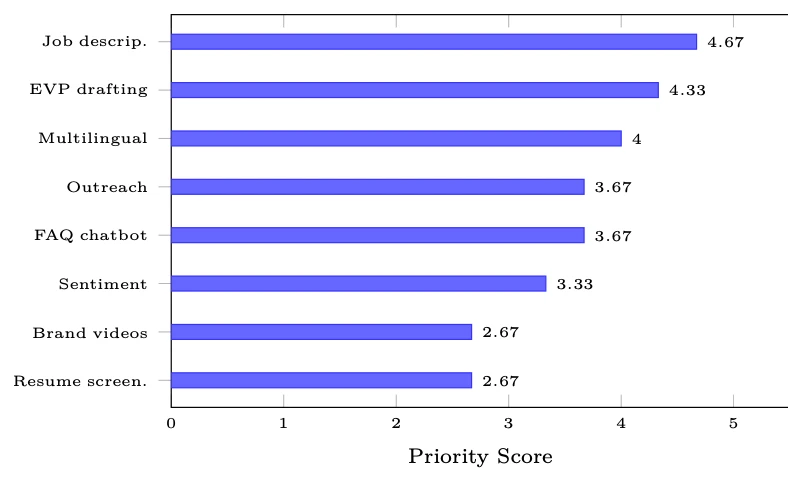
Figure 1 shows three groups. High priority (score above 4): localised job descriptions, employee-story and EVP content drafting. These tasks have high impact, are easy to start and have low risk if a human reviews the output. Medium priority: outreach messages, the FAQ chatbot and review sentiment analysis. These give good value but need more care about privacy, accuracy and tone. Low priority for early adoption: AI-generated videos and avatars, and AI resume screening. Videos need a large budget and can feel artificial. Resume screening has the highest risk because it directly affects who gets a job and is regulated as a high-risk use in several places.
D. The Proposed Five-Stage Model
Based on the analysis, this paper proposes a simple model for using GenAI in international employer branding. It has five stages that are repeated as a cycle, shown in Fig. 2.

The five stages are as follows. Listen: use surveys, reviews and market data (summarised with GenAI if needed) to understand what talent in each region wants and what employees really experience. Create: use GenAI to draft content such as job advertisements, posts, stories and replies, always based on the real EVP. Localise: adapt language, examples, tone and legal wording for each country with the help of local staff. Review: have a trained person check facts, bias, tone and privacy before anything is published. This is the most important stage. Measure: track results and use them to improve the next round.
E. Measuring Success
Table VI summarises the suggested measures for GenAI-supported employer branding.
| Area | Measure | What It Shows |
|---|---|---|
| Reach | Career-page visits; social media engagement by country | Awareness of the employer brand |
| Interest | Click-through and application start rates | Attractiveness of the message |
| Quality | Share of applicants meeting job requirements | Whether messages attract the right people |
| Efficiency | Time to create content; time to fill; cost per hire | Savings from using GenAI |
| Conversion | Offer acceptance rate | Strength of the brand at offer stage |
| Trust | Candidate experience scores; employer review ratings | Whether the brand promise is believed |
| Fairness | Mix of applicants by gender and background; wording checks | Whether content is inclusive |
F. Key Findings
The analysis yields six key findings. (1) GenAI is most useful where work is repetitive and language-heavy; job descriptions, multilingual content and story drafting offer the highest priority scores. (2) Human review is essential; in every stage, GenAI drafts and humans decide, which protects accuracy, fairness and brand authenticity. (3) Localisation is more than translation; cultural tendencies and legal rules differ, so the same content cannot be used everywhere. (4) Risk grows when AI influences hiring decisions; resume screening and ranking need audits, transparency and legal review, and should not be a first step. (5) Authenticity decides trust; AI content that does not match the real workplace may attract candidates in the short term but will reduce trust and retention later. (6) Small firms can benefit most; GenAI allows smaller companies to reach global candidates at low cost, provided they have a simple review process.
VIII. Discussion
The findings agree with employer branding theory. Backhaus and Tikoo (2004) stressed that the brand must be based on real organisational culture. GenAI does not change this principle. It changes only the speed and the cost of producing communication. A company with a weak or unclear EVP will not improve its brand by producing more content faster; it will only spread an unclear message widely.
The analysis also shows a trade-off between speed and trust. GenAI can produce content in seconds, but candidates, especially skilled and experienced ones, quickly notice generic or exaggerated text. The best results will come from using GenAI to remove routine work, so that human teams can spend more time on real stories, real conversations and real improvements to the employee experience.
The cultural view supports Hofstede’s (2001) idea that national cultures differ in what they value. GenAI models are trained on large amounts of data that often over-represent English-language and western content. This means that a first draft may carry western assumptions. Local review is therefore not a formality but a key part of the process.
Finally, the risk and legal analysis shows why companies should start with low-risk content tasks before moving to tools that evaluate people. This order lets the organisation build skills, policies and trust step by step, in line with the risk management approach recommended by NIST (2023).
IX. Managerial and Business Implications
A. For HR Leaders and Employer Brand Managers
HR leaders and employer brand managers should define a clear and honest EVP first, and give it to the GenAI tool as the basis for all content. They should create a short style guide that explains brand voice, words to avoid and inclusive language rules, and use it in every prompt. An approval process should be created: GenAI draft, local review, brand and legal check, then publication. A library of tested prompts should be maintained so that results are consistent across countries.
B. For Recruiters and Marketing Teams
Recruiters and marketing teams should use GenAI for first drafts of job advertisements and outreach, but personalise the final message. Content variations should be tested in small groups before wide release, and the team should learn from the results. AI-generated claims about salary, benefits or policy should never be published without checking them against the official source.
C. For Top Management and Legal Teams
Top management and legal teams should set a company policy on responsible AI use in hiring, including data protection, bias checks and transparency to candidates. Tools that rank or reject candidates should be treated as high-risk, and used only with audits, human oversight and legal advice. Data rules in every hiring country should be checked, particularly the transfer of candidate data across borders.
D. A Simple 90-Day Roadmap
Table VII presents a 90-day roadmap for starting with GenAI in employer branding.
| Period | Actions | Result |
|---|---|---|
| Days 1–30 | Define EVP and brand voice; choose approved tools; write AI use rules; train a small team | Clear foundation and policy |
| Days 31–60 | Start with job descriptions and employee stories in two or three target countries; set up local review | First localised content with human checks |
| Days 61–90 | Add multilingual social content and an FAQ chatbot; begin tracking the measures in Table VI | Early results and lessons |
| After 90 days | Expand to more countries; consider review analysis; evaluate higher-risk tools only with audits | Gradual and safe scaling |
X. Challenges and Limitations
A. Challenges in Using GenAI
Table VIII summarises the main challenges in using GenAI and the ways to reduce them.
| Challenge | Why It Matters | How to Reduce It |
|---|---|---|
| Bias | Output may favour or exclude groups because of patterns in training data | Use inclusive-language checks; review by diverse reviewers; audit regularly |
| Wrong information | AI may invent benefits, facts or policies (hallucination) | Check every claim against official documents |
| Loss of authenticity | Generic text reduces trust and makes all employers sound alike | Use real employee voices; add personal details |
| Cultural errors | Wrong tone, idioms or symbols can offend | Local review; test with local employees |
| Privacy and cross-border data | Candidate data is protected by law in many countries | Do not enter personal data into public tools; follow GDPR, DPDP and local rules |
| Legal risk | AI in selection is regulated or audited in some regions | Seek legal advice; keep humans in control |
| Skills and cost | Teams may lack prompt-writing and review skills | Start small; train staff; use approved tools |
| Over-reliance | Teams may stop thinking critically | Keep human approval at every stage |
B. Limitations of the Study
The study has several limitations. First, it is based on secondary data and does not include interviews or surveys with candidates, employers or recruiters. Second, the priority scores are analytical judgements and not statistically measured values; other researchers might score some use cases differently. Third, GenAI tools and laws change very quickly, so some details may be outdated soon. Fourth, the five regions in the comparison are examples; cultures within a country are also diverse, and the cultural tendencies shown are broad generalisations. Fifth, the study does not measure actual business results such as cost savings or quality of hire.
XI. Future Scope
Future research can extend this work in several directions. Primary research: surveys and interviews with HR managers and job seekers in different countries can test the findings and the priority scores. Experiments: compare human-written and AI-assisted job advertisements and measure application rates, quality of applicants and trust. Case studies: study multinational companies that have adopted GenAI for employer branding, and record their results and problems. Cultural fit of AI: examine how well different language models write for different cultures and languages, especially Indian and other non-English languages. Fairness testing: develop simple methods to check bias in AI-written job advertisements. Newer technologies: study AI agents, real-time translation and personalised career sites as these tools develop.
XII. Conclusion
Generative AI offers companies a practical way to build employer brands that work across countries. It can reduce the time and cost of producing job descriptions, multilingual content and employee stories, and it can help teams understand what talent wants. This study mapped GenAI use to the candidate journey, compared regional needs and ranked eight use cases. The results show that content-related uses have the best balance of impact, ease and risk, while tools that screen or rank candidates carry the greatest risk.
The study also shows that technology cannot replace the basics of employer branding. A brand must be honest, consistent and based on real employee experience. GenAI should therefore be used as a skilled assistant, with humans responsible for accuracy, fairness and cultural judgement. The proposed Listen, Create, Localise, Review and Measure model gives managers a simple and responsible way to start. Companies that combine the speed of GenAI with human judgement and clear ethics will be better placed to attract global talent.
References
- [1] Ambler, T., & Barrow, S. (1996). The employer brand. Journal of Brand Management, 4(3), 185–206.
- [2] Backhaus, K., & Tikoo, S. (2004). Conceptualizing and researching employer branding. Career Development International, 9(5), 501–517.
- [3] Brown, T. B., Mann, B., Ryder, N., Subbiah, M., Kaplan, J., Dhariwal, P., et al. (2020). Language models are few-shot learners. Advances in Neural Information Processing Systems, 33, 1877–1901.
- [4] Creswell, J. W., & Creswell, J. D. (2018). Research design: Qualitative, quantitative, and mixed methods approaches (5th ed.). SAGE Publications.
- [5] Dastin, J. (2018, October 10). Amazon scraps secret AI recruiting tool that showed bias against women. Reuters.
- [6] European Union. (2016). Regulation (EU) 2016/679 of the European Parliament and of the Council (General Data Protection Regulation). Official Journal of the European Union.
- [7] European Union. (2024). Regulation (EU) 2024/1689 of the European Parliament and of the Council laying down harmonised rules on artificial intelligence (Artificial Intelligence Act). Official Journal of the European Union.
- [8] Government of India. (2023). The Digital Personal Data Protection Act, 2023. Ministry of Law and Justice.
- [9] Hofstede, G. (2001). Culture’s consequences: Comparing values, behaviors, institutions and organizations across nations (2nd ed.). SAGE Publications.
- [10] Ji, Z., Lee, N., Frieske, R., Yu, T., Su, D., Xu, Y., et al. (2023). Survey of hallucination in natural language generation. ACM Computing Surveys, 55(12), 1–38.
- [11] Kothari, C. R. (2004). Research methodology: Methods and techniques (2nd ed.). New Age International Publishers.
- [12] National Institute of Standards and Technology. (2023). Artificial Intelligence Risk Management Framework (AI RMF 1.0) (NIST AI 100-1). U.S. Department of Commerce.
- [13] New York City Council. (2021). Local Law 144 of 2021: Automated employment decision tools. City of New York.
- [14] Vaswani, A., Shazeer, N., Parmar, N., Uszkoreit, J., Jones, L., Gomez, A. N., et al. (2017). Attention is all you need. Advances in Neural Information Processing Systems, 30.
© 2026 The Author(s). Published by Journal of Computing and Organizational Studies under a Creative Commons Attribution 4.0 International License (CC BY 4.0).